Cost efficiency and high ROI without permanent infrastructure investments

Guangzhou Chongqi Inflatables Limited
Smart, portable, air-supported structuresdesigned to bypass complex planning permissions and permanent foundation costs.
European MROs, regional airports, and defense contractors face systemic operational bottlenecks. Fixed steel hangars carry a 3–6 month construction window and multi-million Euro CAPEX requirements, requiring permanent civil approvals that often stall in municipal planning departments.
Chongqi inflatable hangars utilize an independent multi-chamber air-supported framework. Rather than relying on a single inflatable volume, every structural air-beam operates as an isolated pressure cell held inside a 3-tonne tensile strength nylon webbing strap grid.
To support high-precision MRO processes, avionics updates, and paint preparation, internal micro-climates must remain tightly controlled.
| Execution Dimension | Traditional Permanent Steel Hangar | Chongqi Rapid Inflatable Solution |
|---|---|---|
| Time to Operational Readiness | 3 to 6 months minimum | 1 to 2 weeks deployment |
| Capital Expenditure (CAPEX) | €1,200,000 – €1,800,000+ | 60% – 70% cost reduction |
| Civil Approvals & Foundation | Heavy concrete foundation + local planning permits | Zero permanent foundation; simple temporary filing |
| Asset Relocation Ability | Fixed location (Sunk Asset) | 100% Mobile; folds into standard containers |
Inflatable hangars maintain structural rigidity by combining positive internal air pressure (typically maintained between 1.5 and 2.0 psi) with high-tensile structural webbings and aerodynamic profiling. Chongqi’s Bullet-Head nose geometry reduces wind drag coefficients by 20–30%, transferring kinetic loads down a network of 3-tonne capacity nylon straps into perimeter ballast tanks or earth anchors. This allows the hangar to withstand sustained winds between 100 km/h and 120 km/h without permanent concrete foundations.
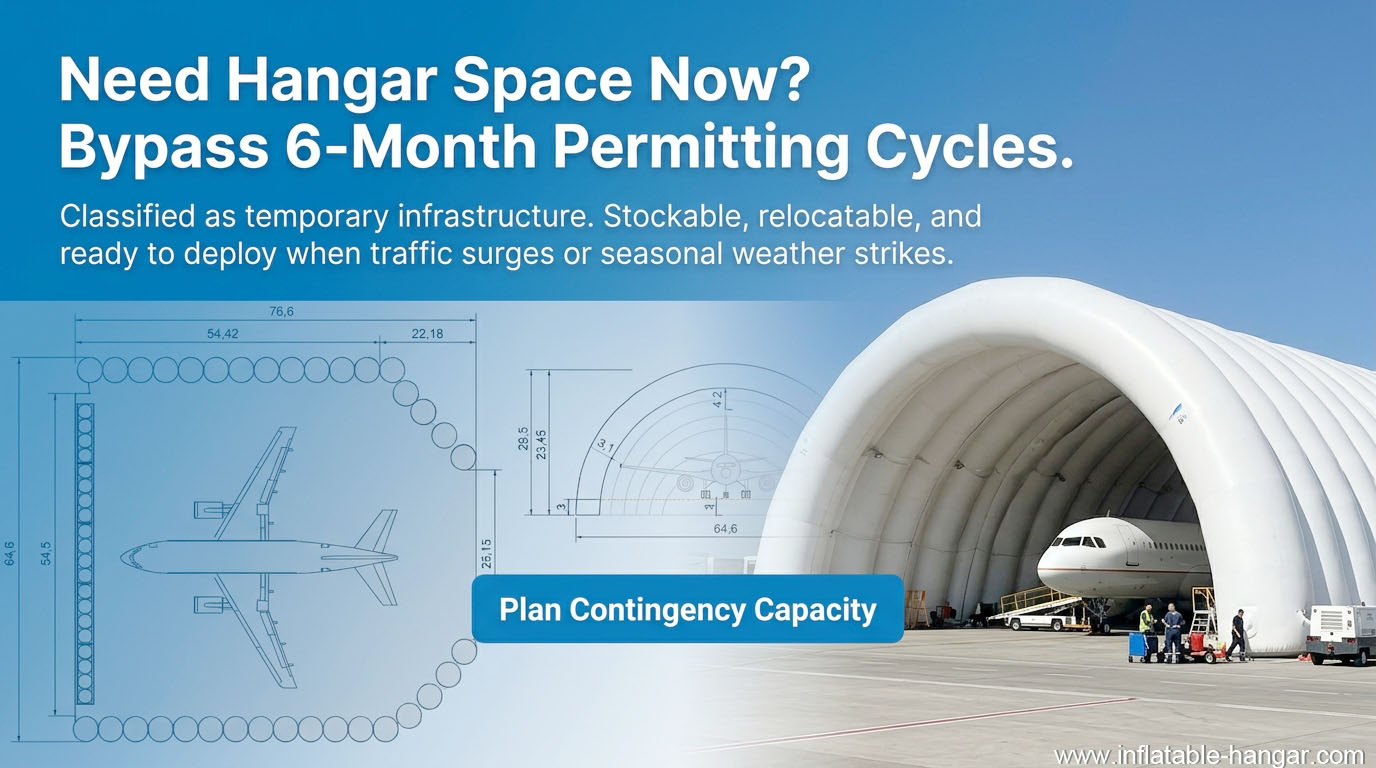
For narrow-body single-aisle jets like the Boeing 737 MAX (wingspan ~35.9m, tail height ~12.3m) or Airbus A320 family, the recommended internal footprint is 55.5m in span by 54m in length, with an interior clear arch height of approximately 12m. This dimension provides complete coverage over the fuselage and vertical stabilizer while preserving a minimum 2.5m peripheral working clearance for ground support equipment (GSE), mobile lifts, and MRO personnel.
No. Modern systems utilize automated pressure regulation units such as the NP06s digital monitoring system. These units maintain internal air tube pressure within an ultra-precise ±0.06 PSI variance, automatically topping off pressure when ambient temperatures drop and venting excess pressure via NP61 relief valves when solar heating expands internal gases. Operational telemetry can be monitored remotely via mobile applications.
Snow accumulation is mitigated through geometry and membrane material properties. The steep semi-circular arch profile combined with slick PVDF exterior fabric coatings forces snow to slide naturally off the roof. In extreme environments, internal air pressure within the closed 0.9mm PVC/PVDF air beams supports roof load capacities exceeding 100 kg/m², while internal HVAC thermal liners prevent cold bridging.
Chongqi hangars utilize a multi-chamber independent air-beam framework. If a single arch suffers surface damage or pressure loss, surrounding air beams held within the exterior strap network absorb structural loads, preventing catastrophic collapse. Local membrane tears can be repaired on-site using heat-welding patch kits without deflating or taking the hangar out of service.
Avoid tying up capital in multi-year civil engineering projects when temporary, flexible cover can be deployed near your flight line in days.
Explore Technical Specifications: www.inflatable-hangar.com
Direct Engineering Consultation: sales@china-inflatables.com
We look forward to collaborating with you to bring Chongqi's innovative inflatable hangars to global airlines, aircraft maintenance companies, and other markets. Contact us for product catalogues, agent agreement details, and market support plans:
Let us seize the growth opportunities in the global aviation market and create a win-win future! We await your response to co-author a new chapter in inflatable buildings.
Yours sincerely.
E-mail: sales@china-inflatables.com Chongqi@china-inflatables.com