
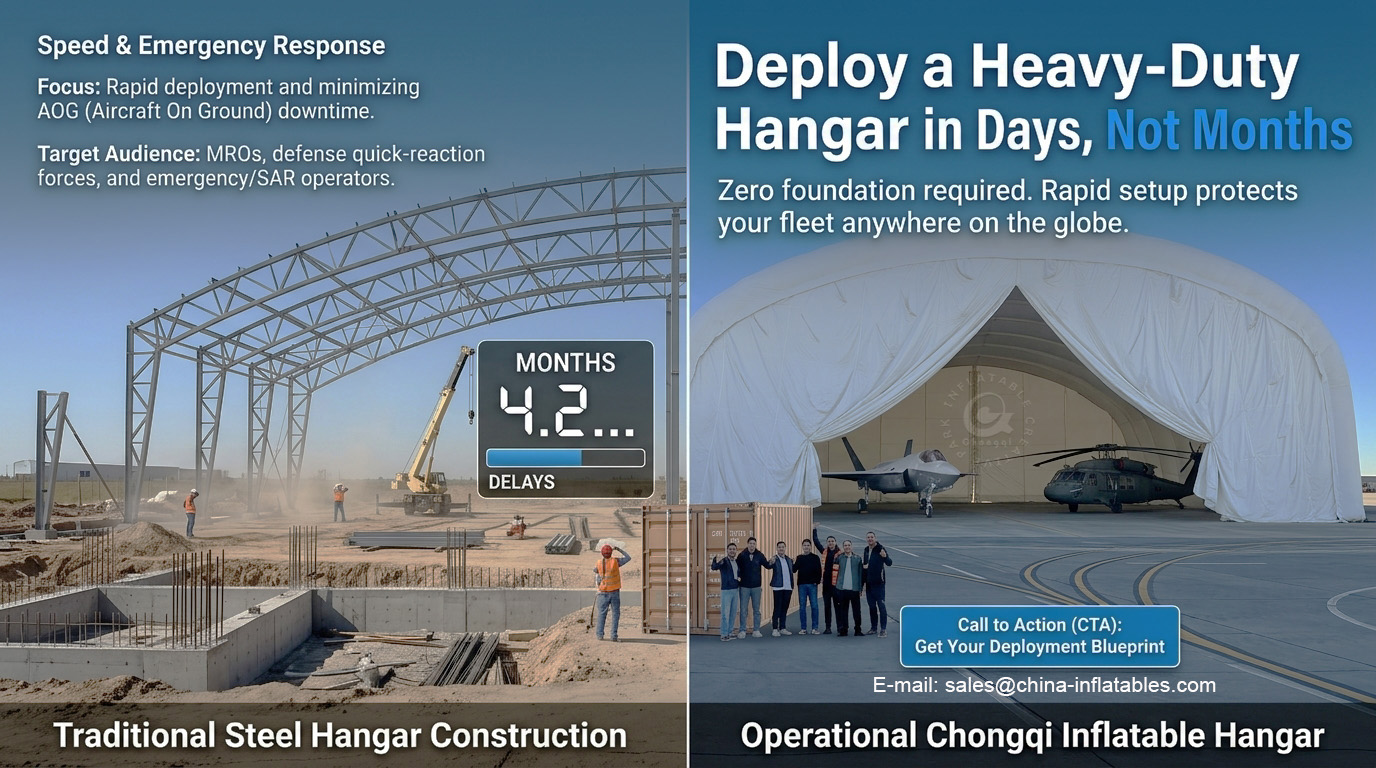
The Paradigm Shift in Aviation Infrastructure: Inflatable Hangars as Strategic Assets
Every time an aircraft sits idle on an apron waiting for hanger availability, money vaporizes. In aviation operations, time isn't just money—it is the ultimate constraint. For decades, fixed steel hangars were treated as an unassailable default. You planned for three years, spent millions in Capital Expenditure (CAPEX), poured thousands of tons of concrete into ground foundations, and prayed that regional route demands wouldn't shift before construction wrapped up.
That paradigm is dead. We are witnessing a transition from static capital traps to dynamic, smart assets. Modern inflatable structures—once viewed as temporary stopgaps—have transformed into engineered, high-tenacity, positive-pressure architectures.
The Analytical Framework: Why Steel is Losing Ground
Consider the value equation of an inflatable hangar system versus traditional infrastructure
- Speed to Operation: 5 to 7 days deployment versus 3 to 6 months of traditional construction (a 99% reduction in setup lead time).
- Capital Efficiency: 70% to 80% reduction in upfront capital costs with zero permanent foundation requirements.
- Residual Value: High residual value retention (55–65%) alongside operational portability across global military and commercial hubs.
Direct Knowledge & Executive Q&A
Inflatable hangars maintain stability by pairing positive-pressure air architectures (typically operating at 1.5–2.0 psi internal pressure) with aerodynamic structural design and heavy anchoring systems. Traditional designs withstand winds up to 80 km/h (50 mph). However, next-generation aerodynamically optimized designs—such as Chongqi's Bullet-Head configuration—reduce air resistance by 20% to 30%, increasing structural stability thresholds to handle wind speeds between 100 km/h and 120 km/h (up to 130 km/h with high-tensile load distribution webbings). Anchoring is achieved via multi-ton sandbags, water bags, or ground tie-downs, avoiding concrete foundation work.
Hangar dimensions must be calculated based on aircraft wingspan, tail height, and clearance required for maintenance crew maneuvering:
- Boeing 737 Series & Airbus A320/A321: Recommended dimensions are approximately 52M–55.5M in width by 54M in length.
- Airbus A330: Requires an expanded layout around 91M x 91M.
- Boeing 747 Series: Requires large-span structures of approximately 100M x 96M.
- Wide-body Custom Architectures (Airbus A350, A380): Demands tailored modular structural configurations designed around specific airport layout parameters.
No. Modern systems employ automated positive-pressure control systems featuring smart pressure monitoring (such as NP06s systems capable of maintaining air pressure variance within an ultra-precise 0.06 PSI range). These systems utilize automatic inflation units that react dynamically to atmospheric temperature changes and pressure drops, controllable and monitored remotely via smartphone applications without manual intervention.
The main envelope consists of double-layer or reinforced PVC/PVDF coated polyester fabrics engineered for high tensile strength, UV resistance, and fire-retardant compliance (CE/RoHS certifications). Load distribution is handled via high-strength internal structural webbings (e.g., 5cm width nylon webbings with up to 3-ton tensile break capacity per strand) connected through stainless steel hardware, offering useful structural lifespans ranging from 8 to 25 years.
Maintenance is modular. Damage to the surface can be repaired using heat-welding patch kits without deflating the structure. For climate control, double-membrane insulation layers paired with zoned HVAC systems maintain internal environmental control for MRO crews working in extreme cold or desert heat environments.
Eliminate AOG Downtime with Rapidly Deployable Infrastructure
Whether you are managing regional jet maintenance schedules, defense quick-reaction deployments, or fleet expansions, waiting months for fixed construction is a operational risk you don't need to take. Contact our engineering team today to receive a full TCO breakdown and tailored structural blueprint for your fleet specifications.
Request Your Customized Hangar SchemeNext Steps: Join Chongqi's and Embark on a Partnership Journey
We look forward to collaborating with you to bring Chongqi's innovative inflatable hangars to global airlines, aircraft maintenance companies, and other markets. Contact us for product catalogues, agent agreement details, and market support plans:
Let us seize the growth opportunities in the global aviation market and create a win-win future! We await your response to co-author a new chapter in inflatable buildings.
Yours sincerely.
E-mail: sales@china-inflatables.com Chongqi@china-inflatables.com